NAD+ Therapy in Miami
Learn how NAD supports cellular energy, recovery, mental clarity, and healthy aging through physician-guided treatment plans
NAD+ Pricing : IV DRIP : $749 packages available
What Is NAD+ Therapy?
NAD therapy is a treatment approach designed to support healthy NAD levels in the body. Because NAD is central to cellular energy metabolism and multiple signaling pathways, maintaining adequate NAD availability may support overall wellness, metabolic efficiency, and recovery.
At Miami Aesthetic Institute, NAD therapy is approached as part of a broader wellness and longevity strategy. Treatment recommendations are individualized and based on symptoms, goals, medical history, and physician evaluation.
Patients interested in NAD therapy in Miami are often looking for support in areas such as:
● Low energy
● Mental fatigue
● Brain fog
● Recovery support
● Healthy aging
● Cellular wellness
● Lifestyle optimization
Related Products:
Basis is a daily supplement proven in clinical trials to increase and maintain NAD+ by 40%. Basis contains 250 mg of the NAD+ precursor NR (Nicotinamide Riboside) along with 50 mg of pterostilbene, a more active form of resveratrol which supports overall DNA and cellular health.
Signal is a daily supplement combining 250 mg of the NAD+ precursor NMN with a SIRT3 Activation Complex to support mitochondrial and metabolic function.
How NAD+ Is Powerful
Every biology textbook has a section on NAD+ (nicotinamide adenine dinucleotide) that describes it as a coenzyme found in all living cells. NAD+ is a molecule used in hundreds of metabolic reactions that create energy for the cell and that influence mitochondrial structure and function. Your cells and those of other mammals, yeast and bacteria, plants too—indeed all life—contain NAD+.
NAD+ was first described in the scientific literature back in 1906 and has been a topic of increasing scientific interest and study since then. Niacin (vitamin B3) was used to help treat and prevent pellagra, an often fatal disease that was prevalent among the poor in the southern United States. Researchers of the time identified several dietary components including milk and yeast that provided relief to pellagra victims. Many sources including dietary components like nicotinic acid and nicotinamide as well as supplements such as nicotinamide riboside have been discovered that activate the NAD+ generating pathways. NAD+ precursors work in the same way as different routes to a particular location would. While each path may vary based on the method of travel, they all end up at the same general destination.
The shiny new molecule that scientists are trying to work into the body to promote longer life and health, NAD+, has become a fairly popular subject in the science community. Scientists are interested in the roles that NAD+ plays in various biological processes and have uncovered many benefits in animals that they hope to replicate in people. So what is so special about NAD+? Well, in short, it acts as a coenzyme or “helper” molecule that is bound to an enzyme that catalyzes (causes) a reaction.
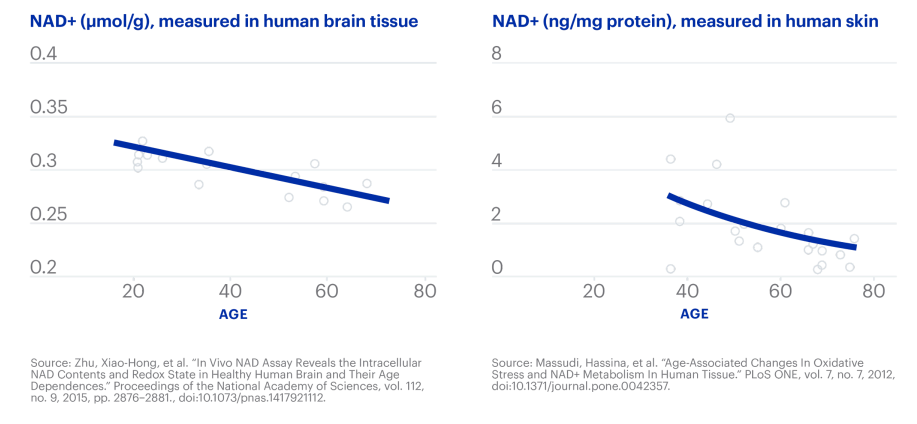
NAD+ isn’t infinite, and our bodies actually make less NAD+ as we age. As we’re learning more about NAD+ and getting it accepted by the scientific community as a legitimate area of research, a ton of studies are starting to be released looking at NAD+ levels and ways to get more.
NAD+ levels decline with age graph
What is the History of NAD+?
NAD+ was first discovered by the British biochemist Sir Arthur Harden and the Scottish biochemist William John Young in 1906 while studying fermentation. Fermentation is the process in which certain yeast cells break down sugar molecules to produce alcohol and carbon dioxide. Harden was nominated for the Nobel Prize for his work on fermentation and 20 years later, in 1929, he was honored with the Nobel Prize in Chemistry, along with Hans von Euler-Chelpin, for his discovery. By further examination of the process of fermentation, Euler-Chelpin discovered that NAD+ is formed of two nucleotides. These nucleotides are the basic units of nucleic acids which comprise DNA. In humans, the key role of NAD+ in metabolic processes was found years after it was discovered by Harden and Young in yeast cells.
According to his 1930 Nobel Prize speech, Euler-Chelpin called the molecule we now know as NAD+ “cozymase” because he thought it was a snappy name. He described it as “vital” and said he and his colleagues studied it at length because “cozymase is one of the most widely distributed and of the greatest biological importance for animals and plants.”
A biologically essential principle of cancer biochemistry was first described by Otto Heinrich Warburg, who received the Nobel Prize in 1931 for his discoveries in relation to respiration. The research on NAD contributed considerably to the understanding of the Warburg effect. In 1931, the American chemists Conrad A. Elvehjem and C.K. Koehn isolated from edible products the pellagra-preventing compound they identified as nicotinic acid. The American United States Public Health Service Doctor Joseph Goldberger was, already before his death, very close to the solution and realized that pellagra was due to the lack of some dietary factor, which he called PPF, the pellagra preventive factor. As the solution to the puzzle was provided after Goldberger’s death, he also contributed significantly to international legislation concerning the enrichment of flours and rice.
According to his own accounts, Nobel Laureate Arthur Kornberg discovered the enzyme responsible for the synthesis of the molecule NAD+ over the next decade. The start of the NAD+ journey had begun. In 1958, scientists Jack Preiss and Philip Handler would go on to describe the steps required to convert nicotinic acid into NAD+, describing it as the Preiss-Handler pathway. Interestingly, nicotinic acid is the form of Vitamin B3 that cured pellagra. By describing this pathway, they made progress in the understanding of how vitamin B3 can be used as a source of NAD+. Some 30 years later, President Ronald Reagan would award Philip Handler the National Medal of Science. The medal recognized Handler’s “outstanding contributions to biomedical research; and his efforts to further the advance of science in the United States.”
Scientists had finally realized how important NAD+ was for the body, but they had no idea how it was affecting the cells. With advances in technology and an increasing awareness of the role of the coenzyme in the body, scientists were encouraged to carry on their research.
The Nuance of NAD+
So NAD+ is really quite an old molecule, even when it comes to our current understanding of its importance, which really begins in the 1960s with the French scientist Pierre Chambon who in vitro using nuclear extracts from hen liver described the phenomenon called poly ADP-ribosylation. NAD+ is broken down into two molecules; one part is recycled back into the form of NAD+ and the other part of the molecule called ADP-ribose binds to a protein. In general, the family of enzymes that utilize NAD+ in the regulation of various cellular processes are known as PARPs or poly (ADP-ribose) polymerases. It is quite interesting to learn that there is another class of enzymes similar to that of PARPs known as sirtuins and they too require the presence of NAD+.
Sirtuins are known as the “guardians of the genome” because of their role in maintaining cellular homeostasis. So what are sirtuins? The proteins were first identified in the 1970s but their NAD+ dependence was only realized in the 1990s. As we mentioned before, Elysium co-founder and MIT biologist Leonard Guarente found out that SIR2, the gene encoding for the sirtuin in yeast, increases the lifespan of yeast only when NAD+ levels are high.
“Without NAD+, SIR2 does nothing. That was the critical finding on the arc of sirtuin biology,” Guarente said.
So there was now clearly a connection between sirtuins and metabolism. There was also a notion that there was a “cross-talk” between biological processes, suggesting that many processes are connected such as that between metabolism and other biological processes. It also brought to the surface an area of research that was hardly explored.
“There are maybe 12,000 papers on sirtuins now. At the time we discovered the NAD+ dependent deacetylase activity the number of papers was in the 100s,” Guarente told F1000 Biology Reports.
Although humans consume NAD+ through their diet as a nutritional supplement, this effect is minimal. Humans consume foods which are amino acid based, and these amino acids can be utilized as NAD+ precursors. However, NR is a far more efficient source of NAD+ than any amino acid. One might think of amino acids as being different roads you can drive on in order to reach a particular place. If that were the case, then NR could be considered a kind of superhighway to that destination which is NAD+.
Researchers attempted to make a better NAD+ supplement. Their minds weren’t on food sources of NAD+. Rather they looked at NR as a very potent means of increasing NAD+. So here’s the question they sought to answer: What can NAD+ do if we have more of it?
How You Can Get More NAD+
There are a few reported ways to maintain or boost levels of NAD+, but only one that has been validated in humans in both lab and clinical trials in a safe and sustainable way: by using NAD+ precursors. NAD+ precursors, as found in our nicotinamide riboside (NR) and nicotinamide mononucleotide (NMN) supplements, Basis and Signal respectively, are the only demonstrated way in clinical trials to safely and sustainably elevate NAD+ levels in the body.
Yes, there are numerous trials that have been conducted using NR and NMN. Our very own trial was published in Nature Partner Journals: Aging and Mechanisms of Disease. It demonstrated that Basis increases NAD+ in whole blood by up to 40%. A trial conducted in Japan gave adults 250 mg of NMN per day and found NAD+ increased by approximately 40% as well. In both cases, the increase was safe (meaning it was not accompanied by any adverse effects) and was sustained for the 8 weeks and 12 weeks of the trials respectively. The NMN trial also found that once supplementation was stopped, the NAD+ levels would revert back to their starting values.
Here’s another way the body may benefit from exercise. Research published in the journal Nature Aging recently looked at the metabolites — the molecules produced as the body’s cells carry out their metabolic processes — in the muscle tissue of younger and older adults, and found that adults with a high level of strenuous exercise had NAD+ levels comparable to that of young adults. (These researchers examined only muscle tissue, so more research would be needed to learn more about whether exercise also influences NAD+ levels in other parts of the body.)
So, what about food? As we mentioned a bit in the last section, many of our foods contain very small amounts of precursors to NAD+. We know that there is a bit of NMN in vegetables like broccoli, cucumber, and cabbage and also in some fruits. There is a small amount of NR in milk products but again in the “low micromolar range,” so in tiny amounts. These amounts are presumably sufficient for the normal operation of the cellular NAD+ system, but insufficient to be used as a compensatory mechanism to deal with the natural decline in NAD+ with age.
The Future of NAD+
Your Appointment May Include:
- Review of symptoms and wellness goals
- Medical history review
- Discussion of energy, recovery, and cognitive concerns
- Review of current supplements or therapies
- Personalized treatment planning
- Follow-up recommendations based on response
Patients Choose Miami Aesthetic Institute Because We Prioritize:
- Physician-guided care
- Personalized treatment planning
- Wellness-focused medicine
- Transparent education
- Realistic expectations